
We discussed two books this month and one extra-credit book: The Burning Season (Caroline Starr Rose), the mountain knows the mountain (Philip Connors), and Fire Season (Philip Connors). The emphasis isn’t trees per se but the ecology of fire and what it means to have a job as a fire lookout.
In Albuquerque, we sometimes have fires along the Bosque and, when they make national news, friends call to ask if I’m okay. I’ve always thought that I’m well protected from fires. And then, last January (2025) there was the Palisades Fire. That included two wake-up calls for me. It was in a city. It was in January (silly me, I thought fires were in the summer). AND then, just to rub it in, so to speak, in June 2025 we had some high winds. A tree in the alley (about 100 ft east of my house) blew against a transformer and pow! No power. I realized just how lucky I was that it hadn’t started a fire. So, even though Albuquerque isn’t a hot spot, so to speak, for fire, we are at risk.
Now, after that lead up, I have to say that none of these books are about fires in a city. They are about the people (fictional and real) who watch for fires. And, it happens that they are watching for fires in the Gila Wilderness.
The Gila Wilderness is unusual in that it has a formal, legal designation as a wilderness area, which has implications for how much development is allowed (more or less none… technically). This is why people are always walking or riding burros in these books. It is why there is no electricity and no running water (apart from water in a cistern). The Park Service has a page of FAQs about wilderness areas.
The best description of what fire in the Gila is about, that I’ve found, is the 16-minute video called Fire Season. Although it isn’t related to Philip Connors’ book, it does go through how fires are spotted and monitored using the 2022 Black Fire as an example. That fire is the fire Connors described at the end of the mountain knows the mountain in his postscript.
One other clip I found that might be of interest is a jeep camping clip. It does give a sense of the isolation of the area but the person drives a jeep the entire way to a lookout tower. Not as remote as what is described by Connors or Rose. On the other hand, this particular video ends (about 22 minutes in) with a walk up the Signal Peak Fire Lookout. You might want to watch this because this is the tower that Rose toured when she was writing her novel. Under the Tall Pines of Gila National Forest // Signal Peak Fire Lookout
Two broadly interesting (that means I couldn’t pick just one or two links on the pages) websites I found are:
The Forest Fire Lookout Association
And then, one additional link related more specifically to the lookout towers. As it turns out, you can buy a lookout tower. They are often taken apart and so you have to haul it out and put it together yourself, but still, how cool is that! Rather interestingly, one of the participants at the discussion had been involved in a demolition project in the Gila during a summer camp many years ago. She confirmed that the remoteness described by both authors of the books we discussed was her experience as well.
The other broadly interesting link, with some subsequent links, is:
The Forest History Society and their youtube page.
And then, just a couple links to talks at the Forest History Society:
“Born of Fire and Rain: What It Means to Be a Forest on a Rapidly Changing Planet” with M.L. Herring
“We Can Do Better”: Paul Johnson and the USDA Natural Resources Conservation Service with Curt Meine
Of course, the author’s website is always a good place to learn more about the author and what they’re up to, including interviews and articles. Here they are for Phillip Connors and for Caroline Starr Rose.

With both books set in the Gila, I tried to find some maps so we could get a sense of the actual locations, especially for Connor’s work, which is memoir, not fiction.
Map 1 of the Gila
Map 2 of the Gila
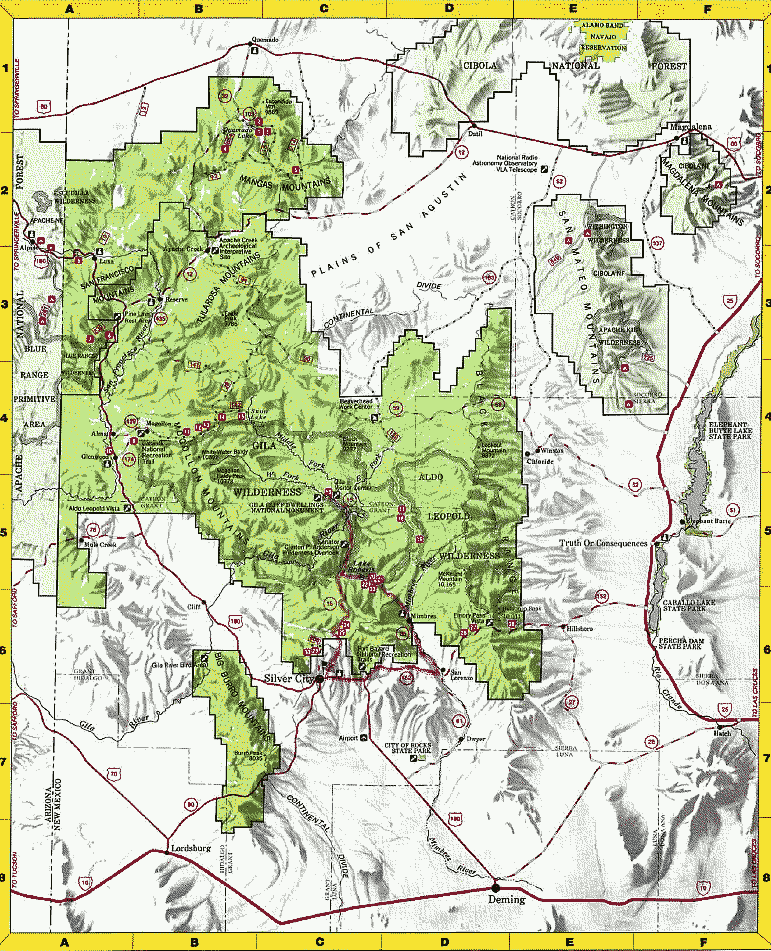
These two short video clips relate both the history of the Gila wilderness and what it’s like today.
USDA Forest Service: Gila Wilderness Celebrating a century of solitude. And here’s a youtube link to the video on the Forest Service page.
Gila pbs For those who attended the 2025 NPSNM Conference in Las Cruces, the narrator of this video, Joe Saenz, was a speaker at that conference.
All three books make reference to the Osborne firefinder. It certainly sounded complicated and was difficult for me to visualize. I found these videos.
This 6 min video shows how to use the Osborne fire finder; or if you’re not near one, how to use a compass to locate a fire. This link goes to the Snoqualmie Fire Lookout Association youtube page where you can find a list of all their fire training videos.
This 2 min 46 sec video clip is done as a checklist to locate wildfire smoke, determine the location, and report the fire.
This 4 min video is an explanation of using the Osborne fire finder by a lookout who has three years of experience but is still learning. I think it’s a good example that this isn’t a simple process although it IS quite precise. It also shows what it looks like in a contemporary lookout tower, complete with a propane stove and some thermos containers.
We think of forest fires or wildfires today in terms of the US Forest Service largely historical approach to fire management.
Think Trees 2023 Lifecycle of a fire incident starting at about 7:50
This is the Tom Swetnam 2023 TTNM Conference talk that I mentioned when we read Tree Story in February 2026: Using Tree Rings to Discover Natural & Cultural History in New Mexico
Swetnam starts talking about fire and fire-scars at about 17 min and at 29 min talks about the Las Conchas fire, which burned so hot that there has been no tree replacement.
And, just a bit of a plug for the Think Trees New Mexico (TTNM) Conference, the source of the two previous links. Whether you’re an arborist or an aspiring arborist, this regionally important annual meeting covers wide ranging topics and has interesting information from gardening tips to pest management to the most unusual explanation of soil I’ve ever heard, to the co-evolution of plants and their preditors from, you know, beginningless time. Best of all, almost all of that information is freely available on their website: https://www.thinktreesnm.org/past-conference-resources/
An unusual combination: Dr. Tom Swetnam (the speaker for the tree rings talk) and Arnold Schwarznegger on a facebook video. Who knew! And, I didn’t know that Swetnam had been a ‘hot shot’ (fire fighter) before becoming an academic.
For those who want to dig really deeper, here’s Tom Swetnam’s 156-page master’s thesis, Fire History of the Gila Wilderness, New Mexico.
There’s a history of how we got to the more or less current approach to wildfire suppression and why that approach has not been, and cannot be, successful in the long run.
This link is to the trailer of the 2022 PBS documentary, The Big Burn. It is a history of the unfortunate combination of rookie Forest Service employees and the drought that led to the 1910 fire “that define[d] the [fledgling US Forest Service” and the nation’s fire policy for much of the twentieth century.
This television interview includes historical footage of the 1910 fire.
Beginning with the 1910 fire, this video describes how suppression became critical and moves on to fires today and how suppression has made fires worse.
Focusing back on NM, the following links provide dates and fire names in New Mexico:
https://www.johnstonsarchive.net/other/newmexicowildfires.html
https://en.wikipedia.org/wiki/List_of_New_Mexico_wildfires
The wikipedia lists are also available by year:
https://en.wikipedia.org/wiki/2025_New_Mexico_wildfires
https://en.wikipedia.org/wiki/2024_New_Mexico_wildfires
There are a number of fire maps available throughout the world and down to state and county level. Prescribed burn maps are also available. Each one of the following links has a slightly different emphasis but you can get a big picture of the fires in our state by checking them all.
USDA Current wildfire information.
Prescribed burns across the US.
AirNow pollution (particulate matter and fires).
NASA world-wide fires.
New Mexico Fire Viewer.
Currently, and as discussed by Connors, people are developing a changing attitude toward fire management. Generally speaking, people in fire management think prescribed burns are critical and long overdue. Here in New Mexico, we’ve been through some very unfortunate and extremely destructive controlled burns that became uncontrolled.
Here are some video clips from the Forest Service:
https://www.fs.usda.gov/about-agency/features/monks-chip-away-wildfire-risk
https://www.fs.usda.gov/about-agency/features/our-forest-bill-due
https://gacc.nifc.gov/swcc/dc/nmsdc/index.php
https://www.fs.usda.gov/about-agency/features/tribal-and-indigenous-fire-tradition
I do know that because of the escaped controlled burns the Forest Service opinions might leave a bad taste in your thoughts but, while their approach to implementation leaves something to be desired, the need for controlled burns really can’t be denied.
And finally, there are things you can do to prepare your own yard to withstand fire.
This first link is to a pdf created by the NM Energy, Minerals and Natural Resources Department (EMNRD). It discusses what makes a plant fire resistent and provides a four-page list of recommended plants. If you do nothing else, you should download (and read) this document.
There is a general sense that one should not have plants within five feet of a structure. This document from the Western Fire Chiefs Association identifies zones and actions to take to minimize the risk from a wild fire.
Within the landscaping plant community, there’s a bit of debate about the no plants within five feet “rule.” Linda Chalker Scott (who spoke on this very topic at the 2026 Think Trees conference in her presentation on “Diagnostic Delusions”) has some thoughts. As she summarizes in one of her blog posts; essentially, if you use fire-resistent plants, mulch with arborist wood chips, and appropriate water to keep the plants healthy and hydrated then the risk of severe fire damage to your house and plants is reduced.
And for those who prefer videos, this is a 54:13 video called Landscaping for Fire Resistance: Native Plant Strategies in a Changing Climate. The talk was sponsored by the Chelan-Douglas Land Trust in Wenatchee, WA. There are some details that aren’t specific to us in NM, however, the basic information is helpful. And, remember, for the specifics, you have already downloaded the EMNRD plant list, right?